이 누리집은 대한민국 공식 전자정부 누리집입니다.
Ganghwa Anglican Church
- Dolmen in Bugeun-ri, Ganghwa
- Chamseongdan Altar, Ganghwa
- Ganghwa Anglican Church
- Golleung Royal Tomb, Ganghwa
- Deokjinjin Fort, Ganghwa
- Outer Wall of Ganghwa Fortress
- Mangsan Beacon Station, Ganghwa (No. 5 Line of Beacon Fire Stations)
- Gareung Royal Tomb, Ganghwa
- Seongneung Royal Tomb, Ganghwa
- Samnangseong Fortress, Ganghwa
- Seonwonsa Temple Site, Ganghwa
- Goryeo Palace Site, Ganghwa
- Gwangseongbo Fort, Ganghwa
- Gapgotdon Outpost, Ganghwa
- Ganghwasanseong Fortress
- Chojijin Fort, Ganghwa
- Hongneung Royal Tomb, Ganghwa
Ganghwa Anglican Church
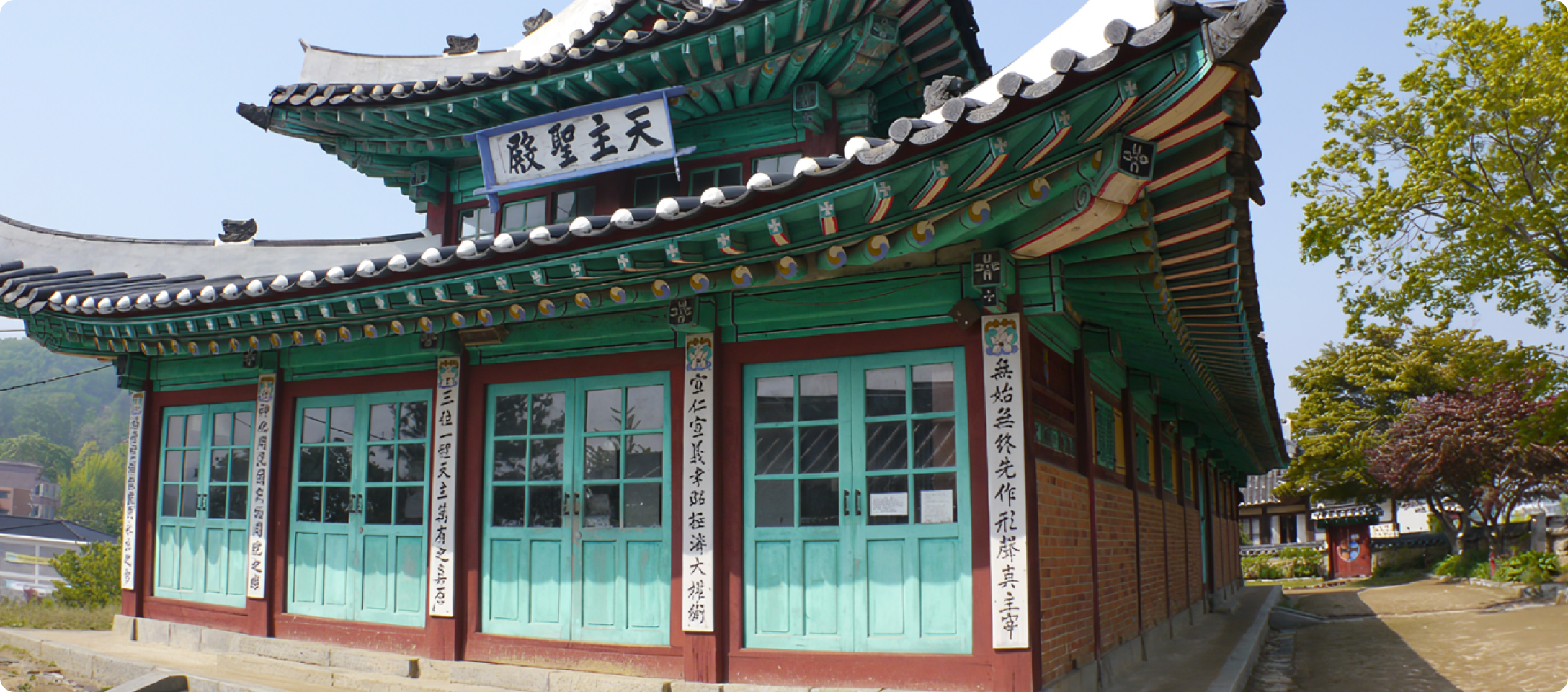
Ganghwa Anglican Church is an Anglican church built in the traditional Korean hanok style in 1900. It was established by C. J. Corfe, the first bishop of the Anglican Church of Korea. The church is notable for its bold combination of the Western European basilica style and the architectural style of East Asian Buddhist temples. Its interior follows the basilica form, while the exterior and surrounding grounds resemble a Buddhist temple, with a traditional Korean timber structure and tiled roof. The overall layout incorporates a Western orientation, with the entrance placed on the west, while also taking the form of a ship (船): the outer and inner three-bay gates and the church bell are positioned at the western end, representing the bow; the church stands at the center; and the rectory is located at the stern. This distinctive arrangement makes the site a valuable resource for the study of Korean architectural history. The timber was transported from the Yalu River, and the building was constructed by palace carpenters who had participated in work on Gyeongbokgung Palace. The entrance steps, outer and inner three-bay gates, church, and rectory are aligned along a southeast-facing longitudinal axis, forming an outdoor spatial arrangement similar to that of a Buddhist temple complex built on hilly terrain (丘陵地伽藍), and two large bodhi trees stand in the courtyard in front of the church. The outer three-bay gate has a raised central section and a hip-and-gable roof and is connected to the surrounding wall, while the gravestone of the first priest (司祭) stands in its eastern bay. The inner three-bay gate is a low gate with a hip-and-gable roof, and its western bay serves as a bell tower. The church has a basilica-style floor plan measuring four bays across the front and ten bays along the sides. Although it is a purely Korean-style timber building with almost no Western ornamentation inside or out, its interior is fully suited to the functions of a church. The building therefore reflects the early Anglican missionaries’ commitment to adapting Christianity to the local cultural context and offers a glimpse into an aspect of the history of Christianity in Korea.
자료관리 담당자
- 담당부서
- 강화군청
- 담당팀
- 전화
- 032-930-3114