이 누리집은 대한민국 공식 전자정부 누리집입니다.
Stone Standing Buddha in Jangjeong-ri, Ganghwa
- Wooden Ksitigarbha Bodhisattva Triad and Ten Underworld Kings of Jeondeungsa Temple, Ganghwa
- Stone Standing Buddha in Jangjeong-ri, Ganghwa
- Five-story Stone Pagoda in Jangjeong-ri, Ganghwa
- Wooden Seated Sakyamuni Buddha Triad of Jeondeungsa Temple, Ganghwa
- Wooden Seated Amitabha Buddha of Cheongnyeonsa Temple, Ganghwa
- Daeungjeon Hall of Jeondeungsa Temple, Ganghwa
- Main Buddha Hall of Jeongsusa Temple, Ganghwa
- Yaksajeon Hall of Jeondeungsa Temple, Ganghwa
- Iron Bell of Jeondeungsa Temple
- Printing Woodblocks for Saddharmapundarika Sutra (The Lotus Sutra)
- Myeonggyeongdae Mirror Stand of Jeondeungsa Temple, Ganghwa
- Iron Seated Amitabha Buddha of Baengnyeonsa Temple, Ganghwa
- Bronze Bell Cast by Buddhist Monk Sain, Ganghwa
Stone Standing Buddha in Jangjeong-ri, Ganghwa
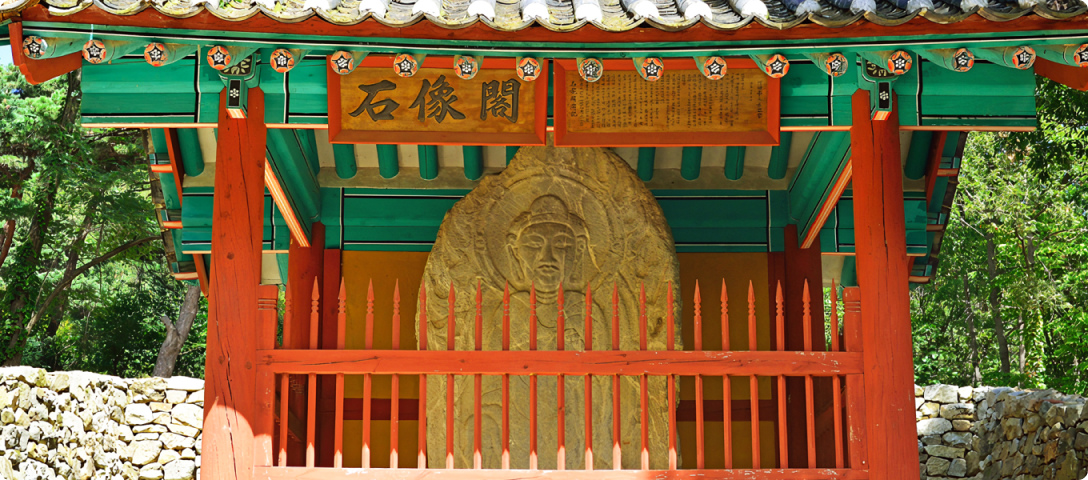
This stone Buddha image, dating from the Goryeo period, is located at the foot of Bongcheonsan Mountain in Ganghwa. It was carved in relief on a thick granite slab and is now enshrined in a protective pavilion. A small, topknot-shaped protuberance known as an ushnisha rises from the crown of the figure’s otherwise smooth head. The oval face is full, while the eyes, nose, and mouth appear somewhat heavy and blunt. The ears are unnaturally elongated, and the figure’s short neck makes the three horizontal folds known as samdo (三道) appear to extend down to the chest. The robe covering both shoulders is rendered so thickly that it obscures the contours of the body. The narrow, rounded shoulder line gives the figure a slightly contracted appearance. U-shaped folds descend from the chest to the knees but are treated in a conventional and simplified manner. The right hand is lowered below the waist with the palm facing outward, while the left hand is raised before the chest with the fingers bent. Two raised lines surrounding the figure distinguish the body halo from the head halo. Sparsely placed round bead motifs are carved between the lines, while flame motifs decorate the outer edges of both halos. The image is characterized by a flat, linear carving style. The overall simplification and omission of detail suggest a relatively late date. Its full face, short neck, contracted shoulders, and conventional drapery folds clearly display the characteristics of Goryeo-period Buddhist sculpture.
자료관리 담당자
- 담당부서
- 강화군청
- 담당팀
- 전화
- 032-930-3114