이 누리집은 대한민국 공식 전자정부 누리집입니다.
Five-story Stone Pagoda in Jangjeong-ri, Ganghwa
- Wooden Ksitigarbha Bodhisattva Triad and Ten Underworld Kings of Jeondeungsa Temple, Ganghwa
- Stone Standing Buddha in Jangjeong-ri, Ganghwa
- Five-story Stone Pagoda in Jangjeong-ri, Ganghwa
- Wooden Seated Sakyamuni Buddha Triad of Jeondeungsa Temple, Ganghwa
- Wooden Seated Amitabha Buddha of Cheongnyeonsa Temple, Ganghwa
- Daeungjeon Hall of Jeondeungsa Temple, Ganghwa
- Main Buddha Hall of Jeongsusa Temple, Ganghwa
- Yaksajeon Hall of Jeondeungsa Temple, Ganghwa
- Iron Bell of Jeondeungsa Temple
- Printing Woodblocks for Saddharmapundarika Sutra (The Lotus Sutra)
- Myeonggyeongdae Mirror Stand of Jeondeungsa Temple, Ganghwa
- Iron Seated Amitabha Buddha of Baengnyeonsa Temple, Ganghwa
- Bronze Bell Cast by Buddhist Monk Sain, Ganghwa
Five-story Stone Pagoda in Jangjeong-ri, Ganghwa
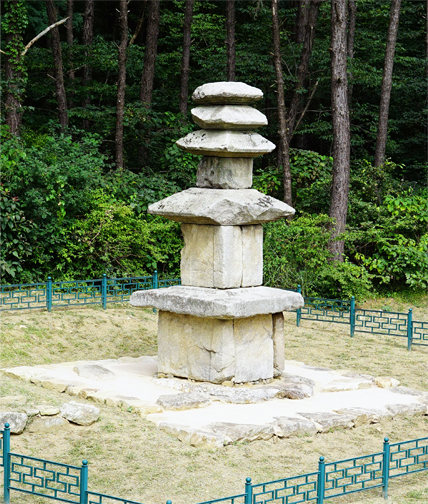
This five-story stone pagoda was built during the Goryeo period. It was found in a collapsed state and was repaired and re-erected in 1960. The pagoda is extensively damaged, and many of its components are missing. The body stones from the third story upward, the roof stone of the fifth story, and the finial have all been lost. The pagoda stands at a former temple site located on the mid-slope of a low hill, although the scale of the temple site is unknown. Goryeo-period artifacts, including fragments of roof tiles decorated with linear and fishbone patterns, roof-end tiles, celadon shards, and white porcelain shards, were discovered and recovered around the stone retaining wall. The pagoda consists of a five-story body set on a single-tier base. Pillar-shaped carvings are found at the four corners of the base. In the body section, only the first-story body stone is assembled from two stone blocks, while each of the body stones above it is made from a single block. The second-story body stone is markedly smaller than the first-story body stone. The underside of the first-story roof stone has four tiers of supports, while those of the remaining stories have three. The undersides of the eaves are flat, with the four corners turning slightly upward. It is regrettable that the corner ridges were damaged when the pagoda collapsed, making it impossible to determine the original degree of their upward curve. The pagoda has an overall heavy appearance. Many decorative details have been omitted, and several elements are rendered in a conventional manner. It is considered a Goryeo-period stone pagoda that inherited the style of Silla stone pagodas, with modifications in its form and tapering proportions.
자료관리 담당자
- 담당부서
- 강화군청
- 담당팀
- 전화
- 032-930-3114