이 누리집은 대한민국 공식 전자정부 누리집입니다.
Bronze Bell Cast by Buddhist Monk Sain, Ganghwa
- Wooden Ksitigarbha Bodhisattva Triad and Ten Underworld Kings of Jeondeungsa Temple, Ganghwa
- Stone Standing Buddha in Jangjeong-ri, Ganghwa
- Five-story Stone Pagoda in Jangjeong-ri, Ganghwa
- Wooden Seated Sakyamuni Buddha Triad of Jeondeungsa Temple, Ganghwa
- Wooden Seated Amitabha Buddha of Cheongnyeonsa Temple, Ganghwa
- Daeungjeon Hall of Jeondeungsa Temple, Ganghwa
- Main Buddha Hall of Jeongsusa Temple, Ganghwa
- Yaksajeon Hall of Jeondeungsa Temple, Ganghwa
- Iron Bell of Jeondeungsa Temple
- Printing Woodblocks for Saddharmapundarika Sutra (The Lotus Sutra)
- Myeonggyeongdae Mirror Stand of Jeondeungsa Temple, Ganghwa
- Iron Seated Amitabha Buddha of Baengnyeonsa Temple, Ganghwa
- Bronze Bell Cast by Buddhist Monk Sain, Ganghwa
Bronze Bell Cast by Buddhist Monk Sain, Ganghwa
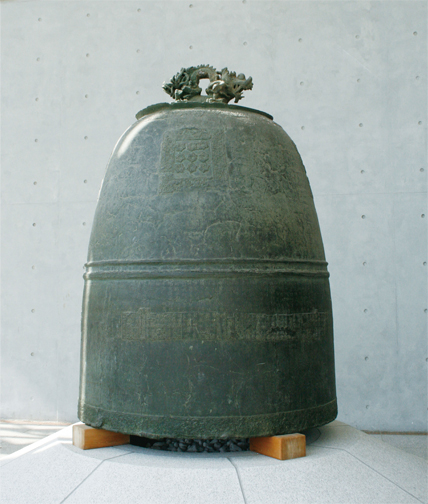
The Ganghwa Bronze Bell was cast in 1711, the 37th year of the reign of King Sukjong, to signal the opening and closing of the gates of Ganghwa Fortress. The original bell was cast in 1688, the 14th year of King Sukjong’s reign, under Yun Ji-wan, the magistrate of Ganghwa, but developed cracks soon afterward. In 1711, Min Jin-won, then magistrate of Ganghwa, had the damaged bell melted down, supplemented with additional metal, and recast at Jeongjoksanseong Fortress. The bell was traditionally believed to have been produced under the direction of Sain (思印), but a recent detailed reading of its inscription established that Sain was the master bellmaker responsible for the damaged original, while Josin (祖信) was the master bellmaker who produced the recast bell. The bell measures 198 centimeters in height and 138 centimeters in diameter at the mouth. At the top, two dragons face in opposite directions with their bodies intertwined, forming the suspension loop. The crown of the bell is rounded in a semicircular form, and an L-shaped ledge runs around the shoulder. This appears to be a modified form of the projecting shoulder decoration of Goryeo-period bells, which featured upright lotus petals. Far below the shoulder are four square lotus panels, each containing nine lotus-shaped bosses. Two thick horizontal lines encircle the middle of the bell body, dividing it into upper and lower sections. Below these lines, the only decoration is a broad floral band immediately above the mouth, and an inscription recording the date of production remains on the bell. The bell is an important resource for the study of Korean bells because it clearly demonstrates the decline of the traditional Goryeo bell style and the emergence of new features of Joseon-period bells.
자료관리 담당자
- 담당부서
- 강화군청
- 담당팀
- 전화
- 032-930-3114